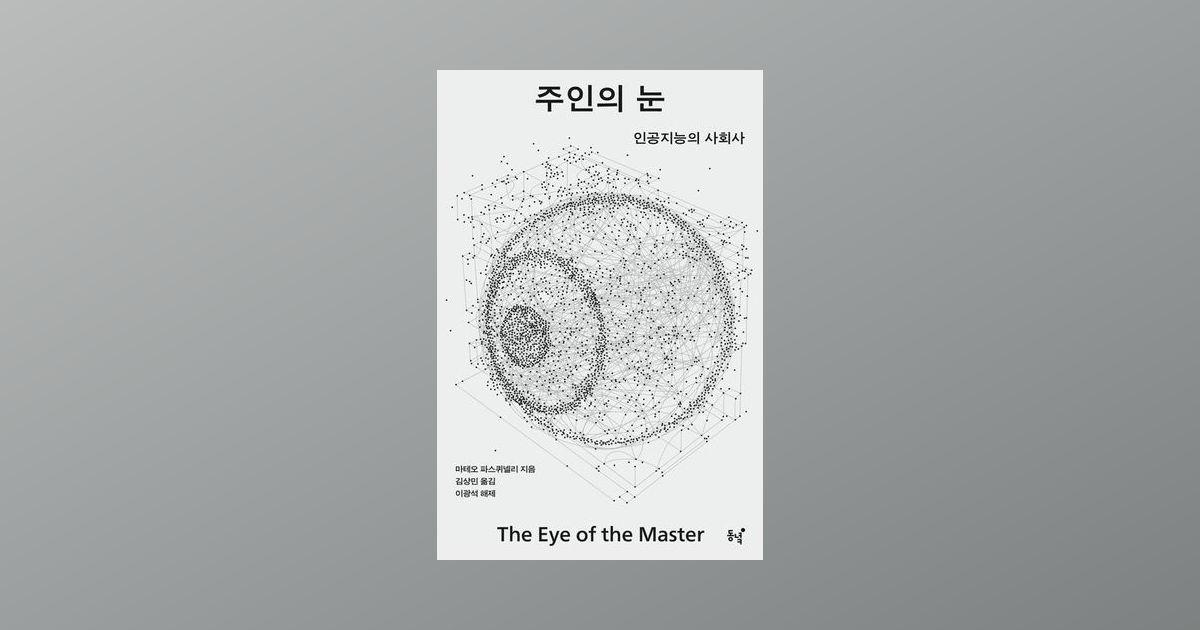
I recently attended a lecture by Prof. Kim Sang-min, a media and cultural studies scholar and the Korean translator of The Eye of the Master. I should say at the outset that I have not yet read it. This is not a review of the book, but an account of what I learned from the lecture and the questions its explanations raised for me.
The lecture approached artificial intelligence as more than a technology modeled on the human brain. It traced the history of intelligent machines through the ways people divided up work, measured tasks, and supervised the labor of others. I was struck by the explanation that, even before industrial machinery appeared, workshops were already mechanical in how they organized labor.
But I also began to think about this account a little differently. If extracting human knowledge and transferring it to machines is a problem, who had been able to enjoy that knowledge before AI? Whose labor sustained their lives so that they could devote their time to intellectual activity?
While Some Thought, Others Worked
Not every intellectual in the past would have belonged to the ruling class. Workers and artisans also produced knowledge through their work, and the history of labor discussed in the lecture gives that knowledge an important place. But the conditions that allowed people to step away from earning a living and spend time on scholarship and reflection were not equally available to everyone.
In Metaphysics, Aristotle explains that fields of knowledge not directly concerned with the necessities of life arose where people had leisure, citing the priestly class in Egypt as an example.Aristotle. Metaphysics, Book I, 981b. We may not be able to apply this account to all of history from today’s perspective, but it is worth considering that individual ability alone does not secure the time needed for intellectual inquiry.
Some people could reflect because they were supported by the labor of others. Here, the distinction between physical and mental labor means more than simply doing different kinds of work. It also concerns who is free to spend their time in certain ways, and which activities are associated with higher status.
Could a society in which machines work in place of people change this relationship? If more people could have time to learn, think, and create without keeping others bound to labor, that would certainly be a change worth hoping for.
But a paradox emerges here.
Today, acquiring and applying knowledge is no longer just a leisure activity for certain classes. Getting an education, building expertise, and doing administrative, planning, design, or analytical work have become familiar routes to earning a living for many people. Thinking, too, has become labor.
In this situation, AI promises to take over human labor. Yet the work it takes over includes the intellectual activities that people once needed freedom from labor to enjoy. We hoped for a technology that would relieve us of work, but that technology now seeks to take on the role of the intellectual as well.
Of course, the history of mechanization cannot be neatly divided into two stages: replacing physical labor, then replacing mental labor. Even the example of Babbage discussed in the lecture concerned the mechanization of mental labor. My question is less about that sequence than about what remains for humans when automation in both areas reaches deep into society.
What Do Humans Do Once Freed from Labor?
I often hear that if machines do the difficult work (closed-ended tasks), humans can do more creative work (open-ended tasks). But I am not sure that is a sufficient answer. We need to reconsider even the division that assigns physical labor to machines and leaves thinking to humans.
We might also consider physical AI, with bodies that move. What if technology continues to develop so that software takes on mental labor and robots take on physical labor? If we allow for that possibility, simply saying that “there will still be things humans do better” does little to help us pursue the question.
In his 1930 essay “Economic Possibilities for our Grandchildren,” Keynes asked how people would use their newfound freedom and leisure once economic necessity had eased.John Maynard Keynes. Economic Possibilities for our Grandchildren (1930). The question that remains for me goes a step further. If AI is better even at the intellectual inquiry we hoped to pursue after being freed from labor, what will humans do with their lives?
Even if AI does something better, people can still think and create. My experience of drawing overlaps with the work of producing a drawing for a client, but they are not the same. Having the result produced for me would not replace what I learn and feel through the process.
But this distinction alone does not resolve the problem. For some people, the activity is a hobby; for others, it is a livelihood. Saying that I can keep drawing is different from saying that I can make a living from it. The pleasure of thinking may remain, but that does not mean the income, role, and social recognition gained through intellectual labor will remain as well.
I do not want to rush to the conclusion that “humans will still have meaning.” Finding meaning and sustaining a livelihood cannot substitute for one another. A change that reduces labor may mean freedom for some, while for others it may mean losing their place in society.
Where does that difference come from? Ultimately, we need to ask not only what AI can do, but also who controls it and the results it produces.
What If It Works for Everyone but Does Not Belong to Everyone?
One question is easy to leave out when we say that AI takes over human work. Who owns the system doing that work and the profits it generates?
If AI is built on the knowledge, expression, and ways of working that people have accumulated over time, who benefits from its use? Being able to use AI does not, by itself, give someone a say in how the technology is operated or how its profits are distributed.
Suppose someone can use AI to finish the same work in less time. Whether the time saved becomes leisure or an added burden of work is not determined by performance alone. Whether they can support themselves without working, or are treated as someone whose work is no longer needed, is also separate from the technology’s capabilities.
This is why I do not want to see “knowledge extractivism” only as the transfer of knowledge. We also need to consider the relationship in which someone’s abilities are incorporated into a technology while the authority to set the terms of its use lies elsewhere.
Being freed from labor takes on a different meaning here, too. Even if AI can do enough to meet society’s needs, most people’s lives become more vulnerable to a tiny minority’s decisions if that minority sets the terms for using AI’s productive capacity. A master who no longer needs to do the work personally and a person for whom there is no longer work to do occupy entirely different positions.
Who, then, are the masters of that society? The heads of Big Tech companies? National governments that exert influence over those companies? It may be difficult to see them as a single, absolute master, but we can certainly ask who holds more decision-making power.
Must a Master Be Worthy of the Position?
At first, I thought, “Shouldn’t a master also bear responsibility?” If someone can make decisions that affect other people’s work and lives, shouldn’t they also accept responsibility for the consequences? Without that sense of responsibility, can they be considered worthy of being a master?
But thinking this question over brings me to a strange point.
“Does someone have to be worthy of the position to become a master in the first place?”
The fact that someone owns something or has secured decision-making power is different from a judgment that they are entitled to exercise that power. Failing to fulfill their responsibilities does not automatically take away the power they already hold. Even if I do not want to recognize someone as a master, their decisions may still affect my life.
“Masters without a sense of responsibility” is therefore not a contradiction in terms. It describes a reality in which those who hold power may not be those who bear the responsibilities that should come with it.
We need to ask how far owning a technology can justify decisions that reshape other people’s livelihoods and social roles. The ability to build AI is not the same as being entitled to decide the conditions of the society it will change.
Those Left Outside the Master’s Gaze
In the lecture, it was noted that the book ends by tracing the history of connectionism, making it difficult to apply directly to today’s AI landscape. What I did not find fully convincing in the explanation I had noted down was the relationship between the scope of the historical account and its ability to explain the present.
In a published interview, the author states that the book’s historical overview extends to the 1960s and focuses on visual AI.Matteo Pasquinelli · Paolo Caffoni. Models of Hand and Head. UMBAU, January 18, 2024. Meanwhile, a published adaptation of its conclusion also discusses modern models such as transformers and GPT.Matteo Pasquinelli. The Automation of General Intelligence. e-flux journal 141, December 2023. That it deals with the past may not be enough to conclude that its perspective is difficult to apply to the present.
For me, beginning with this history made some questions clearer.
“As technologies that work in someone’s place advance, who can be freed from that labor, and who must accept the new conditions?”
If such technologies come to perform both intellectual and physical activities, this question grows larger. We will need to reconsider not only what we can do to earn money, but also through which activities we can participate in society and shape our lives. Yet if even the power to set those conditions is concentrated among those who possess the technology, can we call that future liberation simply because humans no longer have to labor?
I do not yet have an answer about life beyond that point. But I do think it is not enough simply to look for work that will remain for humans. What work remains matters, but we must also ask whether we live in a society where people are granted the right to live only if there is still work for them to do.
Might we end up leaving the masters’ entitlement unquestioned while continuing to demand that only those subject to their decisions prove their usefulness?
- ¹ Aristotle. Metaphysics, Book I, 981b.
- ² John Maynard Keynes. Economic Possibilities for our Grandchildren (1930).
- ³ Matteo Pasquinelli · Paolo Caffoni. Models of Hand and Head. UMBAU, January 18, 2024.
- ⁴ Matteo Pasquinelli. The Automation of General Intelligence. e-flux journal 141, December 2023.