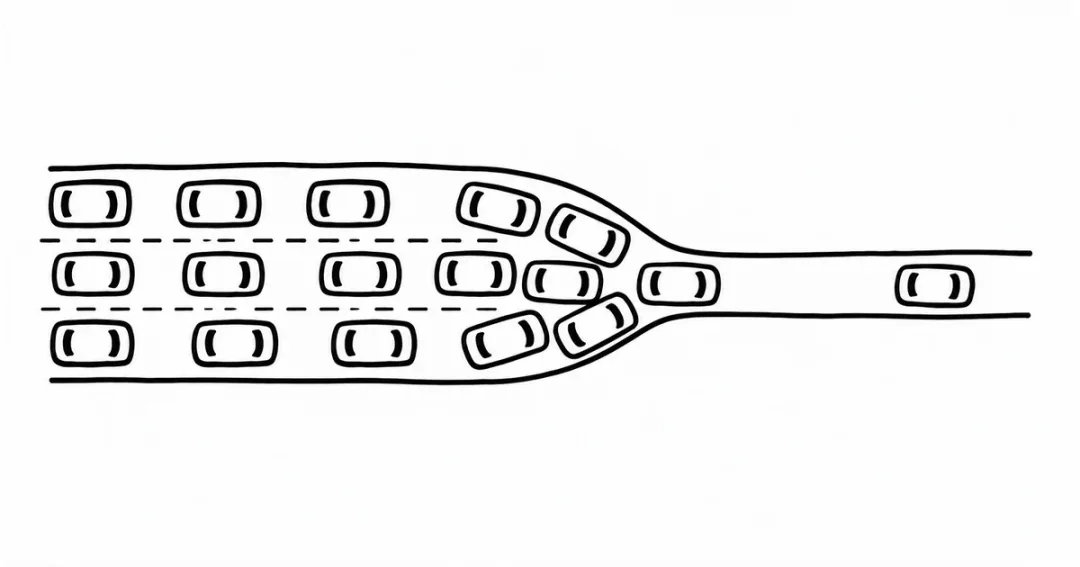
Recent discussions of collaboration with AI brought back memories of my work a little over a year ago. At the time, the organization was full of rosy expectations that AI would let us maximize output with minimal labor. In practice, though, a shorter production time did not mean that all our work would fit together smoothly.
Even when something was made quickly, someone still had to review it, and revisions often took the work back to where it had begun. New tasks would frequently arrive before the previous one was finished. It was hard to tell whether introducing AI had actually shortened the work process or reduced costs in any meaningful way.
Friends who work in other organizations describe much the same experience. They arrive at the same self-deprecating conclusion: “humans are the bottleneck.” By the standards of capitalist efficiency, that may be a fair assessment. Organizations that put output first seek the greatest results at the lowest cost, and would see even the time humans spend checking what AI produces as a cost to be reduced.
But I think there is a more fundamental question to ask here. Who, exactly, are the humans being called a “bottleneck”?
The Paradox of Verification Lagging Behind Production
A recent study of software development by Chen and StrattonChen and Stratton, Artificial Intelligence in the Firm: Bottlenecks in Software Production, working paper version dated October 28, 2026. identifies this dilemma. After AI coding agents were introduced, the time from a request for review to final approval actually increased by about 56%. More code was being produced, but both the wait for review and the review itself took longer, so completed output did not increase in proportion.
According to an interview in the study, there was only one senior developer who understood a particular area of code well and had the authority to approve it, and other heavy responsibilities meant that even this person could take part in reviews only about once a week. On the surface, the reviewer seems an obvious bottleneck. But if approval authority is limited and work is concentrated on that person, what needs examining is probably the distribution of work, rather than the speed of the tool.
Nor would simply spreading approval authority around resolve the problem. Verification cannot be entrusted to someone who does not fully understand the context of the initial requirements and the decisions made along the way. If the system produces output much faster while the size and capacity of the review team remain where they were before AI, I see something closer to a structural flaw. If management measures output only in numbers, it may never understand the bottlenecks people encounter in their work.
Does More Output Mean Success?
He and colleagues’ study,He et al., AI Writes Faster Than Humans Can Review: A Longitudinal Study of an Enterprise “2×” Mandate, revised preprint dated October 27, 2026. meanwhile, shows what changed behind the achievement of a production target after AI was introduced. One company managed to double the number of merged PRsPR (pull request): a request for code to be reviewed and incorporated into a shared codebase. per developer in ten months. In the process, however, the share of PRs with written human feedback fell steeply from 39% to 21%, with “automated review” taking its place.
What matters in this case is not simply higher productivity, but a structural reorganization of review. As I mentioned earlier, organizations want to create more value with fewer people. But if increasing production with AI requires more resources for the review that follows, the initial expectation of cost savings is bound to be disappointed. The way existing staff verify work will have to improve, and that will not happen on its own just because a tool has been introduced.
What concerns me most is that an organization might mistake giving its staff AI tools for improving its processes. If it keeps old approval procedures while demanding that only the people doing the work move faster, I find it hard to see the project as a whole finishing any sooner. The system needs to be redesigned around a sense of what we are checking for, including the removal of redundant verification steps.
The Lower the Barrier to Proposals, the Greater the Burden on Reviewers
Bottlenecks are apparent not only in existing work, but also in the making of new proposals. AI has made it much easier to develop an idea into a proposal. Yet who will assess the resulting volume of documents in depth, and how, is a different kind of problem altogether.
The Ministry of SMEs and Startups’ 2026 “Startup for All” project offers another view of the gap between ease of participation and the capacity for review.Ministry of SMEs and Startups, With 62,000 Applicants, “Startup for All” Leads the Way in Innovation, from First Attempts to Fresh Starts, May 22, 2026. Reports 62,944 first-round applicants and the selection plan. The selection of 5,000 participants is documented in the official material for the first cohort’s launch, June 17, 2026. More than 60,000 people applied, but initially each idea was assigned to a single mentor without cross-checking, and some applicants complained that the assessments had little to do with their applications.Kim Se-yeon, More Than 60,000 Applicants, Yet Even the Number of Evaluators Is Unknown: An Opaque Review Process, Edaily, June 11, 2026; Ministry’s Startup Project to Introduce Multiple Evaluators and AI Verification after Controversy over Opaque Reviews, June 16, 2026. Original reporting on applicants’ complaints, the assessment system, and subsequent changes. The government eventually had to supplement the system, introducing joint review by three evaluators and a minimum character count for feedback.
Imitation Accelerated by AI, New Burdens for Original Creators
In indie games, which might be seen as a frontier of creative work, these problems are becoming a matter of survival. Attempts to use AI to copy someone else’s original idea with ease and bring it to market first are becoming a reality.
The Korean development team YNOT’s suspension of the public demo of Spookitchen over concerns about a copycat release,Yoon Seo-ho, Korean Indie Game Spookitchen Closes Its Demo over Fears of AI Copycats, Inven, October 20, 2026. Reporting on the developer’s announcement and related developments. the demand for money from a developer under the threat of a clone being released first,稲川ゆき, Japanese Indie SRPG Developer Also Receives an Email Threatening to Release an AI Clone First, Game*Spark, October 19, 2026. Reporting on the email shared by the developer and the response. and Alliance Arts’ decision to switch to closed testing because of concerns about imitation all suggest a great deal.Alliance Arts, Change to the Demo Release Plan for Drunken Goddess Reflux, October 16, 2026. Official announcement of the public demo’s cancellation and the switch to closed testing.
How does Valve, which runs Steam, respond to these concerns? At a developer event, Valve explained that cloned games had existed before, but that AI had made them faster to produce. Valve also said it would offer what help it could if threats were reported, but its proposed response to cloning was for developers to build relationships with players and continue improving the original game.Doohyun Lee, Developers Fear AI Slop and Clones — Valve Answers Directly, Inven Global, October 27, 2026. Reporting from Steam Indie Connect. To me, it sounds like a rather irresponsible response to suggest additional operational and development work as the solution for small development teams short of people and time.
What this situation overlooks is that original creators, who ought to be concentrating on their work, have to monitor possible copies themselves, prove their originality, and spend precious time defending their communities. I once saw a demo idea I had shared on a forum implemented in a similar form a few months later, so I do not take these concerns lightly. AI may have reduced the time required for production, but it is passing on substantial subsequent costs to creators in the form of protecting their rights and responding to risks.
Fragmented Work Contexts
Looking at these broader developments brings me back to my own experience at work.
Under a tight schedule of weekly deadlines, when repeated rounds of feedback delayed completion, I found myself under pressure to handle the following week’s new tasks alongside the unfinished work. Managing tasks that required entirely different characters and visual styles at the same time was quite tiring. It was difficult to keep different prompts and contexts intact within a single system, so I had to resort to using personal accounts, which in turn left the work records fragmented.
This was more than a year ago, and the tools have probably improved a great deal since then, but better tools alone do not resolve the burden of taking on new tasks before earlier ones are finished. That is a structural limit arising from how an organization schedules work and allocates people, rather than a matter of workers‘ technical proficiency. AI may make simultaneous tasks possible, but that does not mean an individual’s capacity to keep track of them can expand without limit.
Before Calling Us a “Bottleneck”
It would be premature to attribute all these mismatches solely to flaws in systems humans have made. It would also be dangerous to dismiss every wait for review as an unnecessary delay. Managers and reviewers overseeing several projects have priorities that they must coordinate from the perspective of the organization as a whole.
The key may be to establish more carefully considered criteria. To resolve bottlenecks, there first needs to be a clear agreement on how far approval stages should be reduced, and how schedules should be rearranged when delayed revisions overlap with new tasks. Without these criteria, demanding speed will only repeat a cycle in which workers rush through new tasks and reviewers chase work accumulating in the approval queue.
Organizations will continue to want work done faster and more cheaply. Since AI has accelerated production, it may be natural for them to demand that the verification which follows accelerate too. I suspect that calling humans a “bottleneck” also comes from this pursuit of efficiency.
But I want to ask. If we improve old procedures and finally make review much faster too, will we be able to enjoy time free from pressure? Or will we simply be repositioned as “high-performance components into which more tasks can be crammed”? If an organization’s demands keep rising whenever our capacity improves, humans may continue to be named as the system’s bottleneck.
- ¹ Chen and Stratton, Artificial Intelligence in the Firm: Bottlenecks in Software Production, working paper version dated October 28, 2026.
- ² He et al., AI Writes Faster Than Humans Can Review: A Longitudinal Study of an Enterprise “2×” Mandate, revised preprint dated October 27, 2026.
- ³ PR (pull request): a request for code to be reviewed and incorporated into a shared codebase.
- ⁴ Ministry of SMEs and Startups, With 62,000 Applicants, “Startup for All” Leads the Way in Innovation, from First Attempts to Fresh Starts, May 22, 2026. Reports 62,944 first-round applicants and the selection plan. The selection of 5,000 participants is documented in the official material for the first cohort’s launch, June 17, 2026.
- ⁵ Kim Se-yeon, More Than 60,000 Applicants, Yet Even the Number of Evaluators Is Unknown: An Opaque Review Process, Edaily, June 11, 2026; Ministry’s Startup Project to Introduce Multiple Evaluators and AI Verification after Controversy over Opaque Reviews, June 16, 2026. Original reporting on applicants’ complaints, the assessment system, and subsequent changes.
- ⁶ Yoon Seo-ho, Korean Indie Game Spookitchen Closes Its Demo over Fears of AI Copycats, Inven, October 20, 2026. Reporting on the developer’s announcement and related developments.
- ⁷ 稲川ゆき, Japanese Indie SRPG Developer Also Receives an Email Threatening to Release an AI Clone First, Game*Spark, October 19, 2026. Reporting on the email shared by the developer and the response.
- ⁸ Alliance Arts, Change to the Demo Release Plan for Drunken Goddess Reflux, October 16, 2026. Official announcement of the public demo’s cancellation and the switch to closed testing.
- ⁹ Doohyun Lee, Developers Fear AI Slop and Clones — Valve Answers Directly, Inven Global, October 27, 2026. Reporting from Steam Indie Connect.